Blog title
Hey! I've moved. You'll be directed to my new blog in 3...2...1...

OUCH!

Sunday, October 31, 2010


Do you remember the last time you had a close call? Something that could have changed your life for the worse in a moment? I went for a walk last Sunday to clear my head and enjoy the beautiful autumn day. My foot hit a patch of leaves and underneath were acorns and those walnuts wrapped in a green ball of danger. I went down so fast that I had little time to think about. Maybe 3 seconds.


The first thing that crossed my mind after I hit the ground was broken bones. I prayed that I hadn't done any major harm. I just lay there for a minute assessing the damage. The palms of my hands were bleeding, I was face down to the street and my right ankle hurt a little. I sat up and tested my hands, wrists, and then my ankles and legs. No major damage. Yeah! The next thing I thought: What if I'd broken my wrist or hand or fingers in the midst of revisions? Isn't that just like a writer?


A nice gentleman who worked for the city had seen me hit the sidewalk and helped me up. He was going to give me a ride home, but I was fine. I walked home and had a nice cup of tea thankful that I had no serious injuries. We all need help at sometime or other with something. When's the last time someone helped you up or you went to someone else's rescue? Just for today take time to remember the Good Samaritan.

 Luke 10:30-37 And Jesus answering said, A certain man went down from Jerusalem to Jericho, and fell among thieves, which stripped him of his raiment, and wounded him, and departed, leaving him half dead. And by chance there came down a certain priest that way: and when he saw him, he passed by on the other side. And likewise a Levite, when he was at the place, came and looked on him, and passed by on the other side. But a certain Samaritan, as he journeyed, came where he was: and when he saw him, he had compassion on him, And went to him, and bound up his wounds, pouring in oil and wine, and set him on his own beast, and brought him to an inn, and took care of him. And on the morrow when he departed, he took out two pence, and gave them to the host, and said unto him, Take care of him; and whatsoever thou spendest more, when I come again, I will repay thee. Which now of these three, thinkest thou, was neighbor unto him that fell among the thieves? And he said, He that shewed mercy on him. Then said Jesus unto him, Go, and do thou likewise.

BLOG PICK FRIDAY/ REDWOOD'S MEDICAL EDGE

Friday, October 29, 2010

Jordyn Redwood is a fellow member of American Christian Fiction Writers. She's a nurse with a heart to help not only her patients but those of us interested in medical facts for our fiction. I encourage you to check out her site if you are considering including anything related to nursing/medical information that you may need to know for your works in progress. I'm sure she would welcome your questions.


http://www.jordynredwood.com/2010/10/common-medical-errors-in-manuscripts.html

When Research Surpises/Royal Military Asylum

Tuesday, October 26, 2010

While researching for one of my books recently I came upon the Duke of York's Royal Military Asylum. Hmm. Wonder what that could be? Since I use this post on Tuesdays to explore historical lunatic asylums I figured this must have been like a Veteran's Hospital in the 1800's. But it wasn't. It was a school that opened in 1803 to educate orphans of British military servicemen who were killed during the Napoleonic Wars. I was also surprised to learn that it admitted both boys and girls.
http://upload.wikimedia.org/wikipedia/commons/thumb/e/e6/SaatchiGallery.jpg/300px-SaatchiGallery.jpg

The School is no longer located in this building, which is now called the Duke of York's Barracks. In 1909 the school moved to Dover.


When's the last time you found something that you weren't looking for while researching either for a book you are writing or something else?


http://en.wikipedia.org/wiki/Wikipedia:Text_of_Creative_Commons_Attribution-ShareAlike_3.0_Unported_License

Make Yourself Come True/ Motivation

Sunday, October 24, 2010

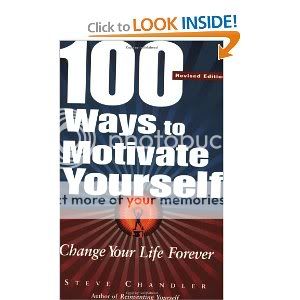
Steve Chandler wrote this little book with big ideas. Actually, there are 100 great ideas in his book titled, 100 Ways to Motivate Yourself. Change Your Life Forever.

If you've ever had difficulty getting motivated to do anything I suggest you go out to your local library or favorite bookstore and pick up a copy of this little gem that packs big ideas.

Motivation. The definiton I like best from Dictonary.com http://dictionary.reference.com/browse/motivation
is: desire to do; interest or drive.


#18 in Chandler's book is: Just Don't Do Something . . . Sit There.


I wish I were sitting here on the beach. Alas, it's not to be for me at this time.

What does this mean to you? Chandler reminds us that Plato said: "Thinking is the soul talking to itself." Does this remind you of something? How about, "Be still and know that I am God." Psalm 46:10.

I'm finishing up my macro edits this week. It can be a tad overwhelming. So today, I'm just going to allow myself the time to "Be still." I'll do this for an hour. That's hard for me because I've got a lot on my plate this week. I'm sure you can relate. But it's important for us to find a quiet place and just sit and think and pray. Then go and do.

For instance, from pages 60-61 Steve recommends you Find Your Inner Einstein. I've never even imagined that I could have an inner Einstein. E=MC2. Do I have an inner Einstein? I don't think so.


But then I read Steve's pages. He says that Einstein said, "Imagination is more important than knowledge." Wait a minute! Wait just a minute. Maybe I do have an inner Einstien. I have imagination!

Steve goes on to tell us about a song for teenagers that Fred Knipe wrote so that teens could visualize themselves succeeding at what they wanted to do:

"That's you/in your wildest dreams/doing the wildest things/no one else can do. If you/just love and keep those dreams/the wildest dreams/you'll make yourself come true."

I LOVE THIS! It's motivating to me. Steve goes on to say,"But the greatest thing about active dreaming is not in the eventual reaching of the goal-- the greatest thing is what it does to the dreamer."

Are you making yourself come true? How? What are you doing? How do you stay motivated?


JUST SIT THERE. JUST IMAGINE.


I've done a post like this previously but deleted it by
mistake. So I've reinvented and revised it.

Blog Pick Friday/Rachelle Gardner's Blog

Friday, October 22, 2010


THE BUSINESS OF WRITING
October 19, 2010

I couldn't pick just one blog post this week. I had to pick two because I thought they were excellent. Both are from my agent, Rachelle Gardner's Blog Site, Rants and Ramblings. http://cba-ramblings.blogspot.com/

AND 

WRITING RULES ARE JUST TOOLS
October 20, 2010


If you haven't read these VERY INTERESTING BLOGS this week. Please do so NOW! You'll love it!

Bedlam Tuesday/Hanwell Insane Asylum

Tuesday, October 19, 2010

The (1st Middlesex) County Asylum at Hanwell, also known as Hanwell Insane Asylum, was built for the pauper insane and has evolved to become the West London Mental Health (NHS) Trust (WLMHT). The 2nd Middlesex was Colney Hatch Asylum, opened in 1851, and the 3rd was Banstead Asylum in Surrey, opened in 1877.              
http://en.wikipedia.org/wiki/Hanwell_Asylum

While researching for my upcoming series I've uncovered a lot of information on line about  Lunatic Asylums all over the world.


DID YOU KNOW? 
In the late 18th century and early 19th century some of the best therapies were already in place. Unlike some of the horror stories we hear today about the history of psychiatry, William Ellis incorporated theraputic employment and the English Quaker, William Tuke, of the York Retreat, band chains or manacles.


In 1817 a William Ellis was appointed as superintendent to the newly built West Riding Pauper Asylum at Wakefield. 

He was born in Alford, Lincolnshire on 10 March 1780. His early career was as an apothecary but he soon took an interest in the treatment of mental disorders. This he learnt at the Sculcoates Refuge in Hull; which was run on a similar model as the York Retreat.

A Methodist, he too had strong religious convictions and so with his wife as matron he employed the same principles of humane treatment and moral therapy as practised at Sculcoates Refuge. After 13 years their reputation had become such, that they were then invited to run the newly built first pauper asylum in Middlesex called the Hanwell Asylum.
 
http://en.wikipedia.org/wiki/William_Charles_Ellis
http://creativecommons.org/licenses/by-sa/3.0/